- 98XXXXXX36
- XXXXXXX@XXX.com
DM Water Plant

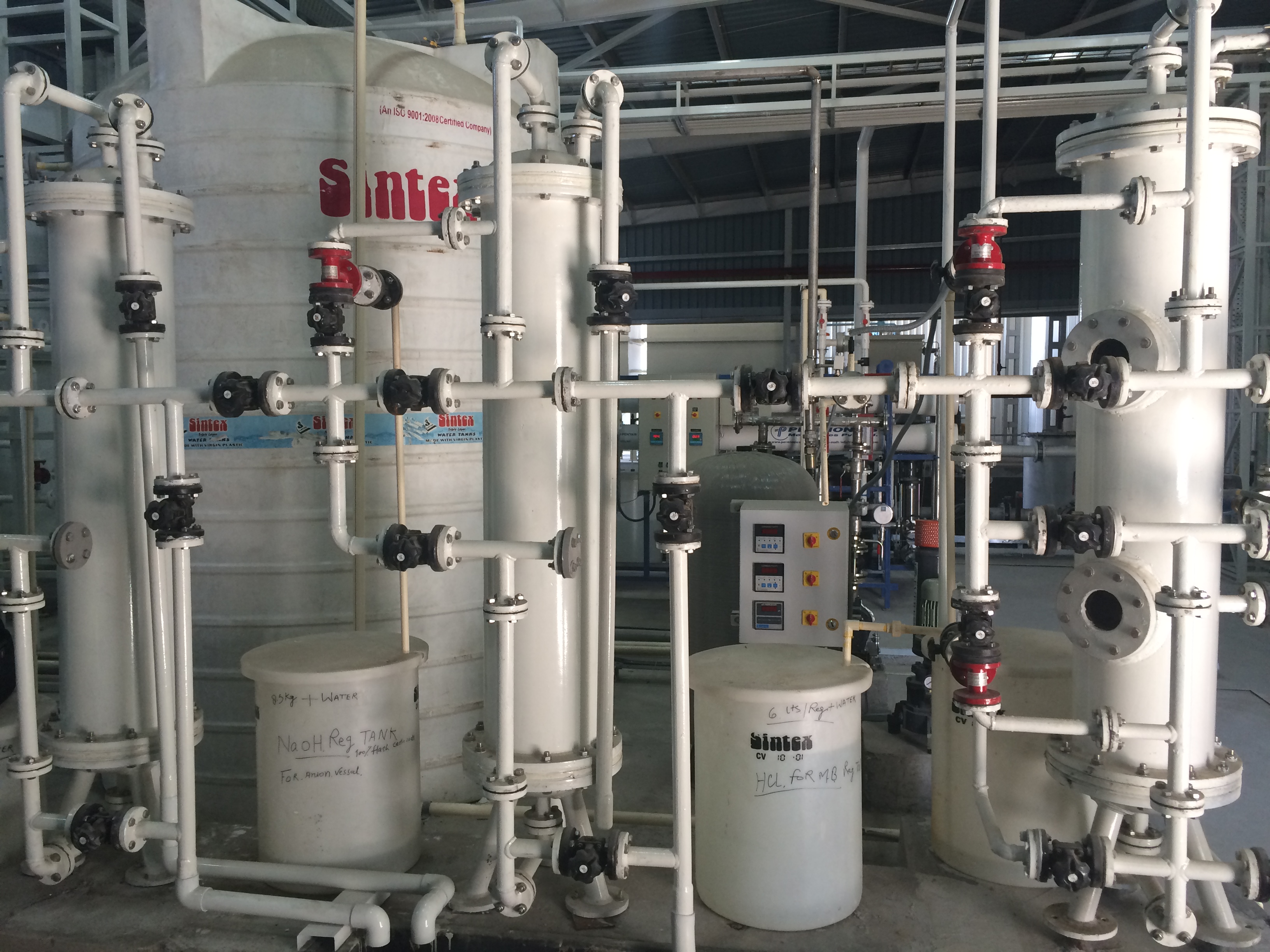
- Model No: ENVIROX - SBA
- Category: Water Treatment Plants and Chemicals
- Keywords: DM PLANT / DEMERALIZER / MIXED BED / DEGASIFIER / TWO BED DEIONIZERS
- Manufacturer Name:
- Packing size:
- Price: ₹375,000
Description
DEMINERALISATION INTRODUCTION For removal of raw water dissolved salts, to make water free from soluble salts of Calcium, Magnesium & Sodium, water demineralization plants are advisable. Raw water which contains chlorides, sulphates & carbonates of Calcium, Magnesium & Sodium make water unfit for use in the pharmaceutical, chemical & battery manufacturer industries and for high pressure boilers. The units can be different types depending on feed water quality and required treated water quality. The process of demineralization defined as under: 1. SAC – SBA 2. SAC – SBA -- MB 3. SAC – DG – SBA 4. SAC – DG – SBA – MB 5. SAC – DG – WBA – SBA 6. SAC – DG – WBA – SBA – MB CATION EXCHANGE In demineralizing, the cation exchange resin is used in the hydrogen form (RH). The ions in the water re actually freely moving but for the purposes of simplicity then may be identified as definite pairs. INLET WATER QUALITY Because an ion exchange resin must be kept clean to function efficiently, the inlet water or raw water must be cold, clean and colorless. The water should be free of suspended matters, organic matter, oil, algae, slime and heavy metals such as iron, aluminum. These impurities would collect on or within the resin particle and reduce their capacity for removal of the ions. Hence waters may require coagulation and filtration prior to being fed into the deionizer. The ion exchange resin particles can act as filters but their deionizing ability and capacity will suffer and the resin bed may then require frequent cleaning or replacement. CAPACITY BETWEEN REGENERATIONS The capacity of the deionizer between regenerations depends on the type and quantity of ion exchange resins used in the columns, the quantity of acid and alkali used per regeneration of each respective column and the dissolved ionic content of the raw water. An economical quantity of regeneration chemical has been specified in the technical data sheet. The capacity between regenerations, if specified, has been based on the design raw water analysis. The concentrations of ions in the raw water is referred t as the ionic load. The cation load is the sum of calcium, magnesium and sodium ionic contact. The anionic load is the sum of chloride, sulphate, nitrate, silica and free carbon dioxide content of the water from the cation column. The concentration of individual ions are normally measured in milligrams/liters as calcium carbonate as (mg/lit. as CaCO3 or parts per million as calcium carbonate as CaCO3). Apart from silica, the other ions present my be considered as existing in two form. Alkaline Salts Neutral Salts The concentration of alkaline salts may be obtained by measuring the total alkalinity to methyl orange (M.Alk.) The neutral salts content is conveniently obtained by measuring the equivalent mineral acidity (E.M.A.) this gives the sum of the anions chloride, nitrate, (phosphate if present). When the concentration of ions are expressed on equivalents per liter or mg./lt. as CaCO3 the total cation content is numerically equal to the total anion content if silica and free carbon dioxide are ignored. It follows that the sum of alkaline salts and neutral salts content gives either the cationic or anionic content. Cationic Load = Total Alkalinity + Equivalent Mineral Acidity Anionic Load = M. Alk. + EMA + Silica + Free CO2 N.B.: All concentrations must be measured mg/lit. or ppm CaCO3. If a degasser is included in the system, the free carbon dioxide present in the water as well as that produced by the splitting up of the alkaline salts is almost all removed by it. The concentration of CO2 remaining after degassing is that which is soluble in water at the particular ambient temperature. For an approximation this may be taken as 6 ppm CaCO3. Passage of water containing sodium chloride, magnesium sulphate and calcium carbonate through the cation exchange resin, results in the removal of the cations by the resin and in their place hydrogen ions are released into the solution. NaCl + RH ---- RNa + HCl …1 Sodium Chloride + Hydrogen Resin Sodium Resin Hydrochloric Acid Mg SO4 + 2RH R2 Mg + H2 SO4 …2 Magnesium Sulphate Hydrogen Resin Magnesium Resin Sulphuric Acid Ca (HCO3)2 2RH R2 Ca 2CO2 +2H2O …3 Calcium Bicarbonate Hydrogen Resin Calcium Resin Carbon Dioxide + Water It will be seen from the equations that the alkaline salt – calcium carbonate, has been split into carbonic acid which being weakly ionized can also be represented as free carbon dioxide and water. The neutral salts have been converted into their respective mineral acids. The treated water is, therefore, acidic and has a low pH. ANION EXCHANGE There are several types of anion exchange resins which differ in basicity. Commonly used are the strong base (SB) anion exchange resins such as type-I or Type-II. The strong base resins are completely ionized throughout the complete pH range and can remove all acids – strong acids such as hydrochloric and sulphuric acids and weak acids such as silica and carbonic acid. Weak base resins are ionized only at a low pH and can, therefore, remove only the strong acid. Weak acids pass through the resin unaffected. In demineralising, the anion exchange resin is used in the basic or hydroxide form. If the treated water from the cation exchange resin is passed through the anion exchange resin, the acids are removed. HCl + ROH RCl + H2O …4 Hydrochloric Acid Hydrogen Resin Chloride Resin Water H2 SO4 + 2ROH R2 SO4 + H2O …5 Sulphuric Acid Hydroxide Resin Sulphuric Resin Water The carbonic acid (free carbon dioxide and water) can also be removed in a similar manner but in some cases it is more economical to remove the carbon dioxide by passing the water downwards through a packed column of reaching rings though which air is blown upwards. This unit is called degasser (see separate introduction sheet if degasser included). For weak base anion exchange resins, the reactions are similar but the process is more correctly represented as acid addition rather than ion exchange. HCl + R R HCl …6 Hydrochloric Acid Basic Resin Hydrochloric Resin Weak acids such as silica and carbon dioxide are not removed. REGENERTION When the supply of exchangeable ions within the resin is exhausted, the treated water from the resin deteriorates and the resin requires regeneration – re-conversion of the resin into the operating form. For cation exchange resins a mineral acid such as hydrochloric acid or sulphuric acid is used. For anion exchange resins, sodium hydroxide (caustic soda) can be used, for al types of resins but for weakly basic resins sodium carbonate (soda ash) can be used. The process is as follows: R Na + HCl RH + NaCl …7 Sodium Resin Hydrochloric Acid Hydrogen Resin Sodium Chloride R2 Mg + H2 SO4 2 RH + Mg SO4 …8 Magnesium Resin Sulphuric Acid Hydrogen Resin Magnesium Sulphate RCl + NaOH ROH + NaCl …9 Chloride Resin Sodium Hydroxide Hydroxide Resin Sodium Chloride R HCl + NaOH R NaCl + H2 O Hydroxide Resin Sodium Hydroxide Basic Resin Sodium Chloride Water Resin Therefore, if a degasser is included Anionic Load = EMA + Silica + 6ppm CaCO3 The capacity of the deionizer is based on the individual ionic load for both the cation and anion exchange resin columns. If there is an increase in either of the ionic loads there will be a corresponding decrease in the capacity between regeneration. TREATED WATER QUALITY The purity of demineralized water is most conveniently assessed by measurement of its electrical conductivity. The electrical conductivity which is conventionally expressed in micro siemens/cm (or micromhos/cm) is influenced by ionizable substances such as sodium chloride, sodium hydroxide, and carbonic acid but not by silica. UNITS USING STRONG BASE ANION RESINS Deionizers which use strong base anion exchange resins produce a treated water virtually free from carbon-dioxide, silica and other dissolved solids. At this stage the pH will be around 8.5 to 9.5 and the electrical conductivity between 5-20 micron s/cm. This quality will be maintained until the point which carbon dioxide and silica (both weak acids) are no longer removed. There will then be a sharp drop in pH to a new level around pH 5 and a rise in conductivity of about 10-20 micro s/cm. At this point the treated water will still be free of sulphates and chlorides but will contain carbon-dioxide and silica. If their presence is objectionable, the unit must be regenerated but if not the unit may be further run until the conductivity further rises and chloride break-through occurs. Although the treated water is very low in dissolved solids has a low conductivity and is substantially more pure than distilled water, the pH is likely to be higher than 7.0. The actual quality is greatly dependent on the raw water quality particularly its sodium ion content. Sodium being monovalent is less efficiently removed by the cation exchange resin. There is therefore a very slight leakage of sodium ions into the treated water from the cation exchange resin. This treated water will therefore contain mineral acidity and a trace of neutral salts such as sodium chloride. This trace of sodium chloride is converted into sodium hydroxide on passage of the treated water through the anion exchange resin. NaCl + ROH RCl + NaOH Sodium Hydroxide Chloride Sodium Chloride Resin Resin Hydroxide The presence of sodium hydroxide has a very marked effort on both the pH and conductivity of treated water. 1 ppm of NaOH results in a conductivity of 6 micro s/cm. 0.4 ppm of NaOH results in a pH of 9.0. The actual leakage of sodium is dependent on the sodium content of the raw water and is not uniform throughout a run. It begins high gradually reduces to a minimum then increases steadily. The pattern of conductivity and pH of the treated water is also similar. The chemical control section should be referred to for further details. UNIT USING WEAKLY BASIC RESINS The use of a weakly basic resin presupposes that the presence of carbon dioxide and silica is not objectionable. The treated water pH will normally be around 5-6 due to the pressure of CO2 and the conductivity will below 35 micro siemens/cm. Leakage of sodium ions will not affect the conductivity or pH markedly as the neutral slat sodium chloride will pass through the anion exchange resin unchanged. 1 ppm NaCl results in a conductivity of 1.8 micron s/cm. NOTE IODION-850 or eq. are medium base anion exchange resin. Because it contains both strong and weak base groups the treated water quality will initially be as described for units using strong base resins – that is pH 8.5 to 9.5, conductivity 5 – 20 micron s/cm. And after about 10-20% of the service output it will be as described for a weak base resin. MIXED BED UNIT Mixed bed demineralizer plant embodies a single column of strong acid cation exchange resin and strong base anion exchange resin, material mixed intimately together. Water passing through the column comes repeatedly in contact with these resins and is thus in effect subjected to an almost infinite number of demineralizing stages. Demineralized water of extreme purity is produced – purity that cannot be equaled by any other commercial method. Mixed bed demineralizers are regenerated with acid and alkali but the ion exchange resin must be separated before this can be done. Bed separation is accomplished by back-washing-this carries the lighter anion resin sinks to the bottom. Two completely separated and super imposed layers are thus formed.