Decanter Centrifuges

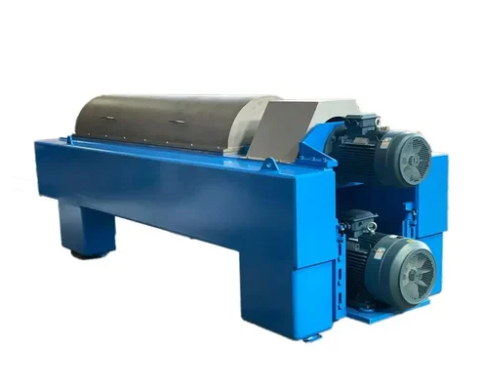
- Model No: WTI/DC/D45C85
- Category: Water Treatment Plants and Chemicals
- Keywords: Decanter Centrifuges Decanter, Centrifuges, Automatic Sludge Seprtator, Sludge Seprator, Screw Press
- Manufacturer Name: Waterneer
- Packing size: 500 to 45000 Ltr
- Price: ₹256,000
Description
A decanter centrifuge is an advanced, continuous solid-liquid separation equipment widely used in industries such as Effluent Treatment Plants (ETP), Sewage Treatment Plants (STP), chemical processing, food industries, and sludge dewatering systems. It operates on the principle of centrifugal force, where separation occurs due to the density difference between solid particles and liquid when subjected to high rotational speed. The equipment consists of a horizontally mounted rotating bowl (cylindrical and conical section), an internal screw conveyor (scroll), a feed zone, a drive system, and separate discharge outlets for solids and liquid. In operation, the slurry is fed into the centrifuge through a stationary feed pipe into the rotating bowl. The bowl typically rotates at speeds ranging from 2,000 to 4,000 RPM, generating centrifugal forces of around 1,000 to 3,000 G, which is significantly higher than gravitational force. Due to this high force, heavier solid particles are pushed outward and deposited along the inner wall of the bowl, forming a sediment layer, while the clarified liquid forms an inner concentric layer. The screw conveyor, rotating at a slightly different speed (differential speed of 5–30 RPM), continuously conveys the settled solids toward the conical end of the bowl, where they are discharged through solids outlet ports. The clarified liquid (centrate) flows toward the opposite end and exits through adjustable weirs or overflow ports. Key technical parameters of a decanter centrifuge include bowl diameter (200–1000 mm), length-to-diameter (L/D) ratio (typically 2.5:1 to 4:1), feed rate (1–100 m³/hr depending on model), solids handling capacity, and cake dryness (typically 18–35% solids for biological sludge, higher for industrial sludge). The machine is driven by a main motor for bowl rotation and a secondary motor or gearbox (planetary or cycloidal) to control the differential speed of the scroll. Modern systems often include Variable Frequency Drives (VFDs) for precise speed control and optimization based on feed characteristics. The performance of the decanter centrifuge depends on several operational parameters such as feed concentration, particle size, temperature, polymer dosing, bowl speed, and differential speed. Polymer dosing systems are often used to improve flocculation and enhance separation efficiency. The unit is usually constructed from stainless steel (SS304/SS316) for corrosion resistance, with wear protection (such as tungsten carbide tiles) in high-wear zones like the scroll flights and discharge ports. Advantages of decanter centrifuges include continuous operation, compact design, minimal manual intervention, ability to handle variable feed conditions, and elimination of filter media. However, they also have certain limitations such as high capital cost, significant power consumption (5–50 kW or more), noise and vibration, and requirement of skilled maintenance. Regular maintenance involves checking bearings, lubrication systems, scroll wear, and alignment. In wastewater and sludge treatment applications, decanter centrifuges play a critical role in reducing sludge volume, increasing solids concentration, and minimizing disposal costs. Their ability to operate continuously and handle large volumes efficiently makes them an essential component in modern industrial and municipal treatment systems.